

Predicting surgical difficulty in liver transplantation: A scoring system to stratify risk

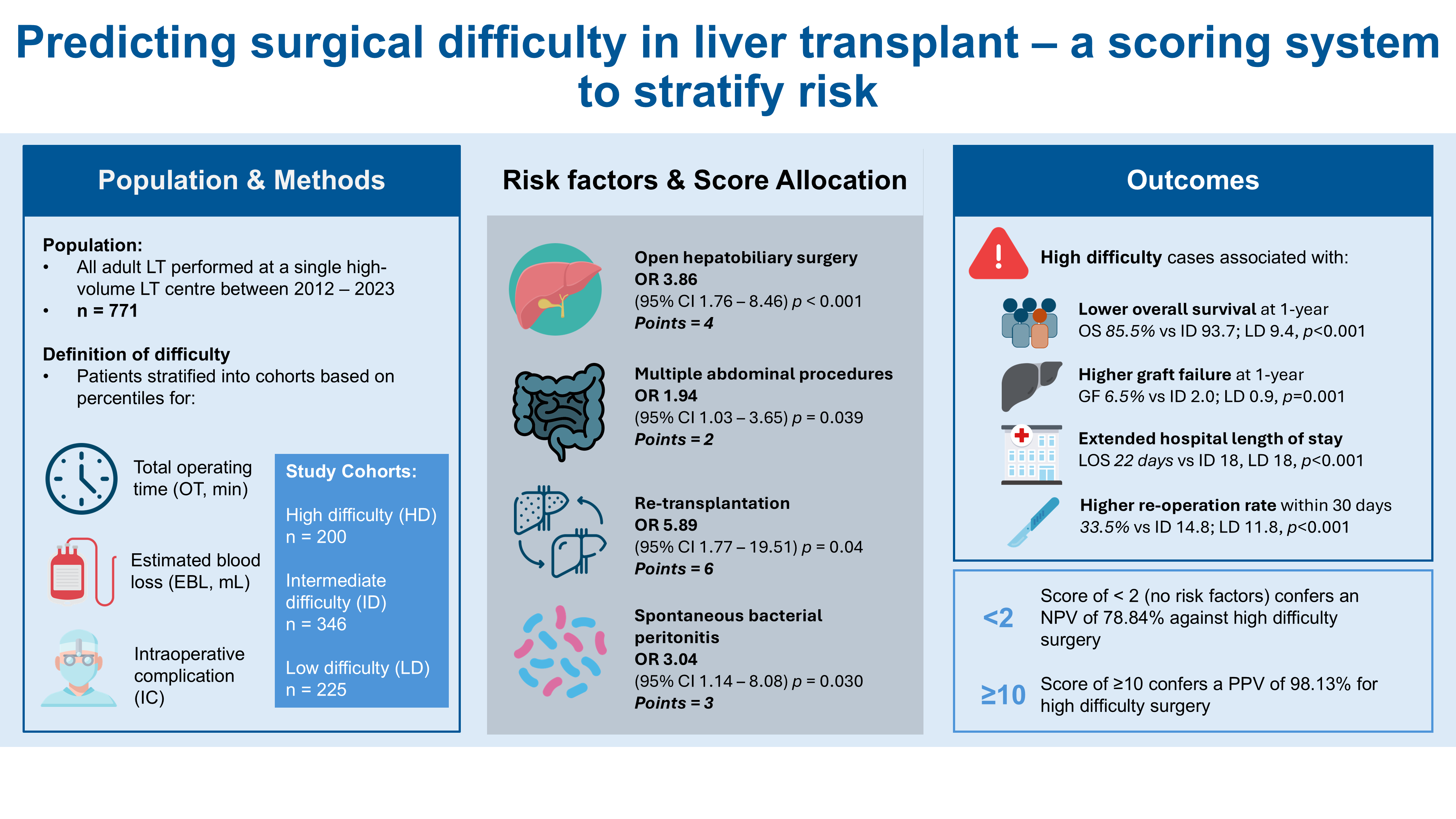
Background: Patients undergoing liver transplantation (LT) are routinely assessed for surgical difficulty, but the predictive value of these assessments are inconsistent. We quantified risk factors for surgical complexity in LT to inform decision making and assist in perioperative planning.
Objective: To risk stratify surgical difficulty in liver transplantation.
Methods: Our prospective LT database (2012–2023) was analysed comparing patients based on surgical difficulty, defined by three surrogate measures (operating time, blood loss, intraoperative complications). Patients were stratified into low (LD), intermediate (ID) and high (HD) difficulty cohorts and compared based on demographic, biochemical, surgical and radiological data. Statistical analysis included ANOVA and chi-square test with multivariate regression to control for covariates.
Results: A total of 771 transplants were included in the study (LD, n = 225; ID, n = 346; HD, n = 200). High-difficulty LT was associated with worse overall survival (HD 85.5%, ID 93.7%, LD 96.4%, p < 0.001) and graft failure (HD 6.5%, ID 2.0%, LD 0.9%, p < 0.001), prolonged hospitalisation and complication rate. Factors predictive of surgical difficulty were multiple prior abdominal surgical procedures (>1, OR 1.94, p < 0.05), prior open hepatobiliary surgery (OR 3.86, p < 0.05), re-transplantation (OR 5.89, p < 0.05) and prior spontaneous bacterial peritonitis (OR 3.04, p < 0.05)
Conclusion: Four variables were associated with significant risk for surgical complexity in LT. These variables have been included into a score with preoperative utility to inform patient risks and plan perioperative resources, but requires external validation prior to clinical implementation.
- Khalil A, Quaglia A, Gélat P, Saffari N, Rashidi H, Davidson B. New Developments and Challenges in Liver Transplantation. J Clin Med. 2023;12(17):5586. doi: 10.3390/jcm12175586
- Azoulay D, Salloum C, Llado L, et al. Defining Surgical Difficulty of Liver Transplantation. Ann Surg. 2023;277(1):144-150. doi: 10.1097/sla.0000000000005017
- Ausania F, Borin A, Martinez-Perez A, et al. Development of a preoperative score to predict surgical difficulty in liver transplantation. Surgery. 2022;172(5):1529-1536. doi: 10.1016/j.surg.2022.07.001
- Martin P, DiMartini A, Feng S, Brown R Jr, Fallon M. Evaluation for liver transplantation in adults: 2013 practice guideline by the American Association for the Study of Liver Diseases and the American Society of Transplantation. Hepatology. 2014;59(3):1144-1165. doi: 10.1002/hep.26972
- Wiesner R, Edwards E, Freeman R, et al. Model for end-stage liver disease (MELD) and allocation of donor livers. Gastroenterology. 2003;124(1):91-96. doi: 10.1053/gast.2003.50016
- Dindo D, Demartines N, Clavien PA. Classification of surgical complications: a new proposal with evaluation in a cohort of 6336 patients and results of a survey. Ann Surg. 2004;240(2):205-213. doi: 10.1097/01.sla.0000133083.54934.ae
- Khan AS, Garcia-Aroz S, Vachharajani N, et al. The learning curve of deceased donor liver transplant during fellowship training. Am J Transplant. 2021;21(11):3573-3582. doi: 10.1111/ajt.16720
- Hallet J, Jerath A, Turgeon AF, et al. Association Between Anesthesiologist Volume and Short-term Outcomes in Complex Gastrointestinal Cancer Surgery. JAMA Surg. 2021;156(5):479-487. doi: 10.1001/jamasurg.2021.0135
- Lonze BE, Parsikia A, Feyssa EL, et al. Operative Start Times and Complications After Liver Transplantation. Am J Transplant. 2010;10(8):1842-1849. doi: 10.1111/j.1600-6143.2010.03177.x
- van Rijn R, Schurink IJ, de Vries Y, et al. Hypothermic Machine Perfusion in Liver Transplantation - A Randomized Trial. N Engl J Med. 2021;384(15):1391-1401. doi: 10.1056/NEJMoa2031532
- Tang LCY, Chetwood JD, Lai MSM, et al. Incidence, epidemiology, and outcomes of acute allograft rejection following liver transplantation in Australia. Liver Transpl. 2024;30(10):1039-1049. doi: 10.1097/lvt.0000000000000375
- Kaldas FM, Horwitz JK, Noguchi D, et al. The Evolution of Redo Liver Transplantation Over 35 Years: Analysis of 654 Consecutive Adult Liver Retransplants at a Single Center. Ann Surg. 2023;278(3):441-451. doi: 10.1097/sla.0000000000005962
- Memeo R, Laurenzi A, Pittau G, et al. Repeat liver retransplantation: rationale and outcomes. Clin Transplant. 2016;30(3):312-319. doi: 10.1111/ctr.12691
- Salimi J, Jafarian A, Fakhar N, et al. Study of re-transplantation and prognosis in liver transplant center in Iran. Gastroenterol Hepatol Bed Bench. 2021;14(3):237-242.
- Ausania F, Al Shwely F, Farguell J, et al. Factors Associated with Prolonged Recipient Hepatectomy Time During Liver Transplantation: A Single-Centre Experience. World J Surg. 2020;44(10):3486-3490. doi: 10.1007/s00268-020-05643-7
- Silva JP, Berger NG, Yin Z, et al. The effect of prior upper abdominal surgery on outcomes after liver transplantation for hepatocellular carcinoma: An analysis of the database of the organ procurement transplant network. Surgery. 2018;163(5):1028-1034. doi: 10.1016/j.surg.2017.10.072
- Mounzer R, Malik SM, Nasr J, Madani B, Devera ME, Ahmad J. Spontaneous bacterial peritonitis before liver transplantation does not affect patient survival. Clin Gastroenterol Hepatol. 2010;8(7):623-628.e1. doi: 10.1016/j.cgh.2010.04.013
- Yang J, An S, Oh N, et al. 333.3: Impact of Previous Abdominal Surgery on Laparoscopic Donor Hepatectomy for Living Donor Liver Transplantation. Transplantation. 2022;106(9S):S277. doi: 10.1097/01.tp.0000886848.73985.78
- Kim SH, Kim KH, Ha TY, Jung DH, Park GC, Lee SG. Salvage living donor liver transplantation for recurrent hepatocellular carcinoma after prior laparoscopic hepatectomy. Hepatobiliary Pancreat Dis Int. 2018;17(5):473-476. doi: 10.1016/j.hbpd.2018.09.014
- Combari-Ancellin P, Nakada S, Savier É, et al. Initial laparoscopic liver resection is associated with reduced adhesions and transfusions at the time of salvage liver transplantation. HPB (Oxford). 2024;26(9):1190-1199. doi: 10.1016/j.hpb.2024.06.001
- Jochmans I, Fieuws S, Tieken I, Samuel U, Pirenne J. The Impact of Implantation Time During Liver Transplantation on Outcome: A Eurotransplant Cohort Study. Transplant Direct. 2018;4(6):e356. doi: 10.1097/txd.0000000000000793
- Pothet C, Drumez É, Joosten A, et al. Predicting Intraoperative Difficulty of Open Liver Resections: The DIFF-scOR Study, An Analysis of 1393 Consecutive Hepatectomies From a French Multicenter Cohort. Ann Surg. 2021;274(5):805-813. doi: 10.1097/sla.0000000000005133
- Aziz A, Ito T, Younan S, et al. The Impact of Previous Abdominal Surgery in a High-Acuity Liver Transplant Population. J Surg Res. 2021;258:405-413. doi: 10.1016/j.jss.2020.08.064