

Digital-twin prototype for lumbar fusion

Background: Existing spine digital twins model anatomy and biomechanics rather than outcomes under alternative operative plans.
Objective: To develop and evaluate an electronic health record-based lumbar fusion digital twin integrating calibrated outcome prediction with counterfactual simulation of alternative surgical decisions.
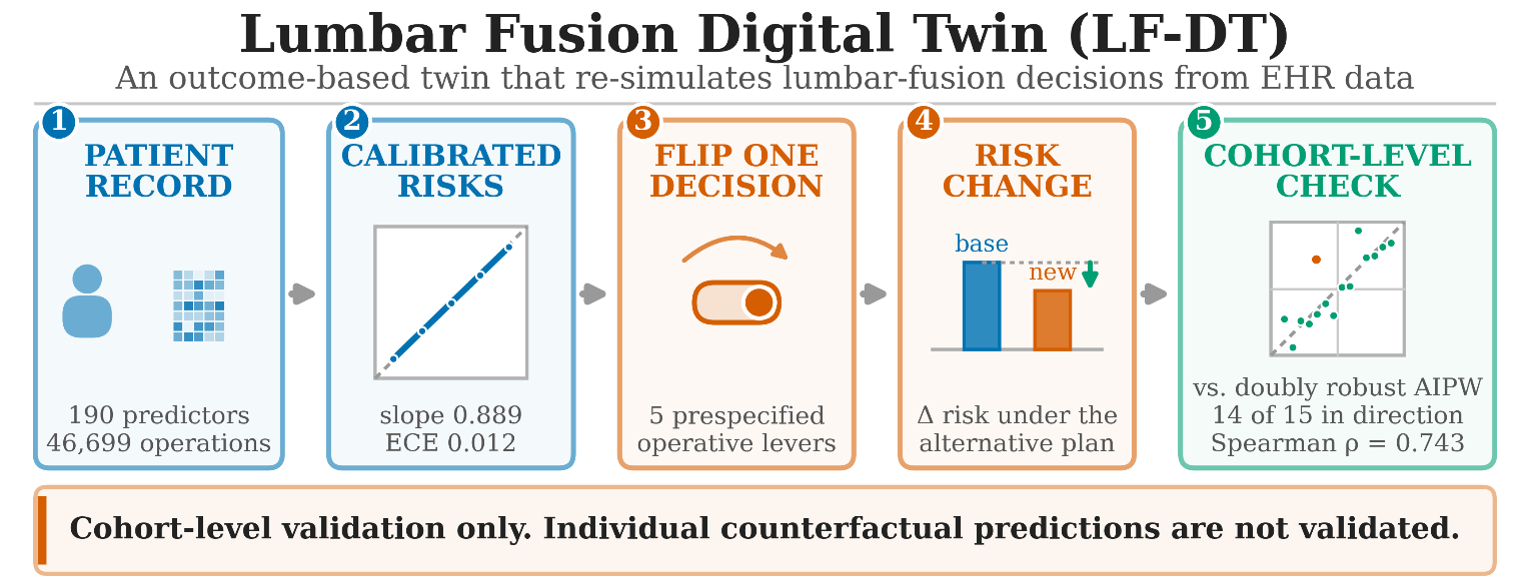
Methods: We developed the lumbar fusion digital twin (LF-DT), an electronic health record-based framework pairing calibrated multi-outcome prediction with counterfactual re-simulation of lumbar-fusion decisions. From the TriNetX federated network, we assembled 46,699 lumbar-fusion operations with 190 predictors, reserving the most recent 7,680 as a temporal holdout. G-computation estimated outcomes under alternative decisions; cohort-level contrasts were benchmarked against augmented inverse-probability-weighted (AIPW) estimates across 15 decision-outcome comparisons, and four negative controls assessed residual bias.
Results: LF-DT and AIPW agreed in direction for 14 of 15 contrasts, with strong rank association (Spearman ρ = 0.743) and moderate absolute concordance (Lin concordance correlation coefficient, 0.594; 95% CI: 0.169–0.720). LF-DT attenuated effect magnitudes. In the holdout, the 30-day composite model achieved an area under the receiver operating characteristic curve (AUROC) of 0.687 (95% CI: 0.675–0.699), expected calibration error 0.012, and calibration slope 0.889, against an AUROC of 0.637 for a three-feature comparator; across 16 binary channels, median AUROC was 0.756 and median calibration slope 0.95. The data are retrospective and observational, so these estimates are associative and confounding by indication cannot be excluded. LF-DT was validated at the cohort level only. Its individual counterfactual predictions have not been validated and must not be used for patient counseling or preoperative planning.
Conclusion: Outcomes included complications, readmission, and reoperation; patient-reported measures were not included; and one network cannot provide external validation. Prospective multi-institutional evaluation is required before clinical use.
Level of Evidence: III (Prognostic, Retrospective)
- Shabbak M, Ehteshami S, Shojaei SH, Nazar E, Eghbali A, Karimi M. Incidence and predictors of early and late reoperation after primary lumbar spine fusion: a 10-year retrospective cohort study of 1,356 patients. Eur Spine J. Published online July 4, 2026. doi: 10.1007/s00586-026-10161-6
- Park P, Nerenz DR, Aleem IS, et al. Risk factors associated with 90-day readmissions after degenerative lumbar fusion: an examination of the Michigan Spine Surgery Improvement Collaborative (MSSIC) registry. Neurosurgery. 2019;85(3):402-408. doi: 10.1093/neuros/nyy358
- Sivaganesan A, Zuckerman S, Khan I, et al. Predictive model for medical and surgical readmissions following elective lumbar spine surgery: a national study of 33,674 patients. Spine (Phila Pa 1976). 2019;44(8):588-600. doi: 10.1097/BRS.0000000000002883
- Baaj AA, Lang G, Hsu WC, et al. 90-day readmission after lumbar spinal fusion surgery in New York State between 2005 and 2014: a 10-year analysis of a statewide cohort. Spine (Phila Pa 1976). 2017;42(22):1706-1716. doi: 10.1097/BRS.0000000000002208
- Su AW, Habermann EB, Thomsen KM, Milbrandt TA, Nassr A, Larson AN. Risk factors for 30-day unplanned readmission and major perioperative complications after spine fusion surgery in adults: a review of the National Surgical Quality Improvement Program database. Spine (Phila Pa 1976). 2016;41(19):1523-1534. doi: 10.1097/BRS.0000000000001558
- Katz AD, Mancini N, Karukonda T, Greenwood M, Cote M, Moss IL. Approach-based comparative and predictor analysis of 30-day readmission, reoperation, and morbidity in patients undergoing lumbar interbody fusion using the ACS-NSQIP dataset. Spine (Phila Pa 1976). 2019;44(6):432-441. doi: 10.1097/BRS.0000000000002850
- Glinkowski WM, Gieroba T, Śliwczyński A. Digital twins in orthopedics and trauma: concepts, emerging evidence, and barriers to clinical translation. J Clin Med. 2026;15(11):4127. doi: 10.3390/jcm15114127
- Beaulieu E, Daffner M, Obraitis D, et al. Advances in biomechanical modeling of lumbar spine diseases and tumors: gaps, opportunities, and AI integration. Front Bioeng Biotechnol. 2026;14:1786433. doi: 10.3389/fbioe.2026.1786433
- Hani H, Knapik GG, Bourekas EC, Marras WS. Biomechanical models of lumbar spine degeneration: methods, challenges, and clinical promise. Clin Biomech (Bristol). 2025;130:106675. doi: 10.1016/j.clinbiomech.2025.106675
- Wang MC, Kiapour A, Massaad E, Shin JH, Yoganandan N. A guide to finite element analysis models of the spine for clinicians. J Neurosurg Spine. 2024;40(1):38-44. doi: 10.3171/2023.7.SPINE23164
- Knapik GG, Mendel E, Bourekas E, Marras WS. Computational lumbar spine models: a literature review. Clin Biomech (Bristol). 2022;100:105816. doi: 10.1016/j.clinbiomech.2022.105816
- Hwang C, Kim J, Bae J, Lim D, Jang GW. Real-time prediction of lumbar spine stress and displacement using a proof-of-concept digital twin biomechanical model. Ann Biomed Eng. Published online May 20, 2026. doi: 10.1007/s10439-026-04185-8
- Landinez D, Rodríguez CF, Cifuentes-De la Portilla C. Patient-specific spine digital twins: a computational characterization of the idiopathic scoliosis. J Orthop Surg Res. 2025;20:39. doi: 10.1186/s13018-024-05417-0
- Hein J, Giraud F, Calvet L, et al. Creating a digital twin of spinal surgery: a proof of concept. In: 2024 IEEE/CVF Conference on Computer Vision and Pattern Recognition Workshops (CVPRW). Piscataway, NJ: IEEE; 2024:2355-2364. doi: 10.1109/CVPRW63382.2024.00241
- Carbonaro A, Marfoglia A, Nardini F, Mellone S. CONNECTED: leveraging digital twins and personal knowledge graphs in healthcare digitalization. Front Digit Health. 2023;5:1322428. doi: 10.3389/fdgth.2023.1322428
- Kovatchev BP, Colmegna P, Pavan J, et al. Human-machine co-adaptation to automated insulin delivery: a randomised clinical trial using digital twin technology. NPJ Digit Med. 2025;8(1):253. doi: 10.1038/s41746-025-01679-y
- Shamanna P, Joshi S, Dharmalingam M, et al. Digital twin in managing hypertension among people with type 2 diabetes: 1-year randomized controlled trial. JACC Adv. 2024;3(9):101172. doi: 10.1016/j.jacadv.2024.101172
- Karabacak M, Jagtiani P, Schupper AJ, Carr MT, Steinberger J, Margetis K. Machine learning for individualized risk estimation in anterior lumbar interbody fusion. Neurosurg Pract. 2024;5(3):e00099. doi: 10.1227/neuprac.0000000000000099
- Cui P, Tao H, Zhang H, Wang P, Chen X, Lu S. Data-driven clustering for risk stratification of unfavorable outcomes after lumbar fusion surgery: a development study. Neurospine. 2026;23(2):473-486. doi: 10.14245/ns.2551770.885
- Robins J. A new approach to causal inference in mortality studies with a sustained exposure period: application to control of the healthy worker survivor effect. Math Model. 1986;7(9-12):1393-1512. doi: 10.1016/0270-0255(86)90088-6
- Hernán MA, Robins JM. Using big data to emulate a target trial when a randomized trial is not available. Am J Epidemiol. 2016;183(8):758-764. doi: 10.1093/aje/kwv254
- Bang H, Robins JM. Doubly robust estimation in missing data and causal inference models. Biometrics. 2005;61(4):962-973. doi: 10.1111/j.1541-0420.2005.00377.x
- Alba AC, Agoritsas T, Walsh M, et al. Discrimination and calibration of clinical prediction models. JAMA. 2017;318(14):1377-1384. doi: 10.1001/jama.2017.12126
- Khan SS, Greenland P, Hayman LL, et al. Criteria to assess the predictive and clinical utility of novel models, biomarkers, and tools for risk of cardiovascular disease: a scientific statement from the American Heart Association. Circulation. 2026;153(11):e953-e970. doi: 10.1161/CIR.0000000000001401
- Kattan MW, Vickers AJ. Statistical analysis and reporting guidelines for CHEST. Chest. 2020;158(1):S3-S11. doi: 10.1016/j.chest.2019.10.064
- Huang Y, Li W, Macheret F, Gabriel RA, Ohno-Machado L. A tutorial on calibration measurements and calibration models for clinical prediction models. J Am Med Inform Assoc. 2020;27(4):621-633. doi: 10.1093/jamia/ocz228
- Hoogland J, Efthimiou O, Nguyen TL, Debray TPA. Evaluating individualized treatment effect predictions: a model-based perspective on discrimination and calibration assessment. Stat Med. 2024;43(23):4481-4498. doi: 10.1002/sim.10186
- Efthimiou O, Hoogland J, Debray TPA, et al. Measuring the performance of prediction models to personalize treatment choice. Stat Med. 2023;42(8):1188-1206. doi: 10.1002/sim.9665
- Maas CCHM, Kent DM, Hughes MC, et al. Performance metrics for models designed to predict treatment effect. BMC Med Res Methodol. 2023;23(1):165. doi: 10.1186/s12874-023-01974-w
- Desai RJ, Glynn RJ, Solomon SD, Claggett B, Wang SV, Vaduganathan M. Individualized treatment effect prediction with machine learning: salient considerations. NEJM Evid. 2024;3(4):EVIDoa2300041. doi: 10.1056/EVIDoa2300041
- Elixhauser A, Steiner C, Harris DR, Coffey RM. Comorbidity measures for use with administrative data. Med Care. 1998;36(1):8-27. doi: 10.1097/00005650-199801000-00004
- Guo C, Pleiss G, Sun Y, Weinberger KQ. On calibration of modern neural networks. In: Precup D, Teh YW, eds. Proceedings of the 34th International Conference on Machine Learning. Vol 70. Proceedings of Machine Learning Research; 2017:1321-1330.
- Pakdaman Naeini M, Cooper GF, Hauskrecht M. Obtaining well calibrated probabilities using Bayesian binning. Proc AAAI Conf Artif Intell. 2015;29(1):2901-2907. doi: 10.1609/aaai.v29i1.9602
- Collins GS, Moons KGM, Dhiman P, et al. TRIPOD+AI statement: updated guidance for reporting clinical prediction models that use regression or machine learning methods. BMJ. 2024;385:e078378. doi: 10.1136/bmj-2023-078378
- Kurz CF. Augmented inverse probability weighting and the double robustness property. Med Decis Making. 2022;42(2):156-167. doi: 10.1177/0272989X211027181
- Shardell M, Chen C, McCoy RG. Doubly robust causal modeling to evaluate device implantation. JAMA Intern Med. 2024;184(7):834-835. doi: 10.1001/jamainternmed.2024.1181
- Chatton A, Le Borgne F, Leyrat C, et al. G-computation, propensity score-based methods, and targeted maximum likelihood estimator for causal inference with different covariates sets: a comparative simulation study. Sci Rep. 2020;10(1):9219. doi: 10.1038/s41598-020-65917-x
- Vansteelandt S, Keiding N. Invited commentary: G-computation—lost in translation? Am J Epidemiol. 2011;173(7):739-742. doi: 10.1093/aje/kwq474
- Vasey B, Nagendran M, Campbell B, et al. Reporting guideline for the early-stage clinical evaluation of decision support systems driven by artificial intelligence: DECIDE-AI. Nat Med. 2022;28(5):924-933. doi: 10.1038/s41591-022-01772-9
- Labkoff S, Oladimeji B, Kannry J, et al. Toward a responsible future: recommendations for AI-enabled clinical decision support. J Am Med Inform Assoc. 2024;31(11):2730-2739. doi: 10.1093/jamia/ocae209
- Salman S, Phadke R, Kumar R, Momin A, Tavakkoli A. Risk prediction in spine surgery: a scoping review of traditional models, artificial intelligence, and the challenge of clinical translation. Spine Deform. Published online April 13, 2026. doi: 10.1007/s43390-026-01365-3
- Salman SG, Phadke R, Kumar R, Zaman N, Tavakkoli A. Digital twins and multimodal artificial intelligence in spine care: a scoping review of concepts, evidence, and translational barriers. Spine Deform. Published online May 8, 2026. doi: 10.1007/s43390-026-01397-9
- Srinivas R, Phadke R, Salman S, et al. Endoscopic versus open lumbar decompression: a retrospective cohort study of 31,000 patients with 90-day follow-up. Neurosurg Rev. 2026;49(1):240. doi: 10.1007/s10143-026-04179-z
- Salman SG, Phadke R, Carlin T, et al. Fracture Orthopedic Risk of Non-Home Discharge Score II (FORD-II). Injury. 2026;57(10):113527. doi: 10.1016/j.injury.2026.113527
- Phadke RA, Salman SG, Salman ZG, et al. Ordinal deep learning for lumbar foraminal stenosis grading on sagittal MRI. J Imaging. 2026;12(8):388. doi: 10.3390/jimaging12080388